



/Eploy-Team-3-News-banner.png?center=0%2C0&height=175&heightratio=1.915151515151515&width=336)
It aims to transform how neurodivergent individuals are perceived and supported by providing schools, universities, organisations, and others around the world with the opportunity to recognise the many skills and talents of neurodivergent individuals, while creating more inclusive and equitable cultures that celebrate differences and empower every individual.
In this blog, we cover:
- Data that paints a clear picture of what neurodivergent candidates face during the hiring process.
- A list of barriers in the traditional hiring process.
- What adjustments are most significant to neurodivergent candidates across every hiring stage.
- Answers to frequently asked questions about neuroinclusive recruitment.
Zurich’s survey results reveal that 63% of neurodivergent adults, who participated in the survey, shared that employers see neurodiversity as a ‘red flag’, rather than a strength, so it is unsurprising that 47% feel they can’t or shouldn’t disclose their neurodiversity to recruiters or hiring managers. This data cements an undeniable reality - neurodivergent candidates still face significant barriers in the recruitment process, and the Neurodiversity Celebration Week acts as a great reminder to reflect and better understand the positive impact of following neuro-inclusive practices.
Is Your Hiring Process Creating Barriers?
‘’Policies alone don’t create change — practice does. Employers and organisations need to build neuroinclusion into the full employee journey: from fair hiring and onboarding to progression and retention. The focus should be on actionable, inclusive systems that improve experiences not only for neurodivergent employees, but for everyone in the workplace.’’ Neurodiversity Celebration Week
Around 1 in 7 people are neurodivergent. While 63% of Zurich’s survey respondents share that things have improved for neurodivergent people at work compared to past years, and more than half find it easier to disclose neurodiversity than it used to be. Yet it’s still important to ensure that reasonable adjustments are in place to enable all candidates to feel they’ve been enabled to bring their best from application to interview.
Some of the significant barriers in traditional hiring processes are:
- Unconscious bias in recruitment decisions.
- Rigid interview structures that don’t accommodate different thinking styles.
- Lack of workplace adjustments, leading to exclusion.
How can you support neurodivergent candidates?
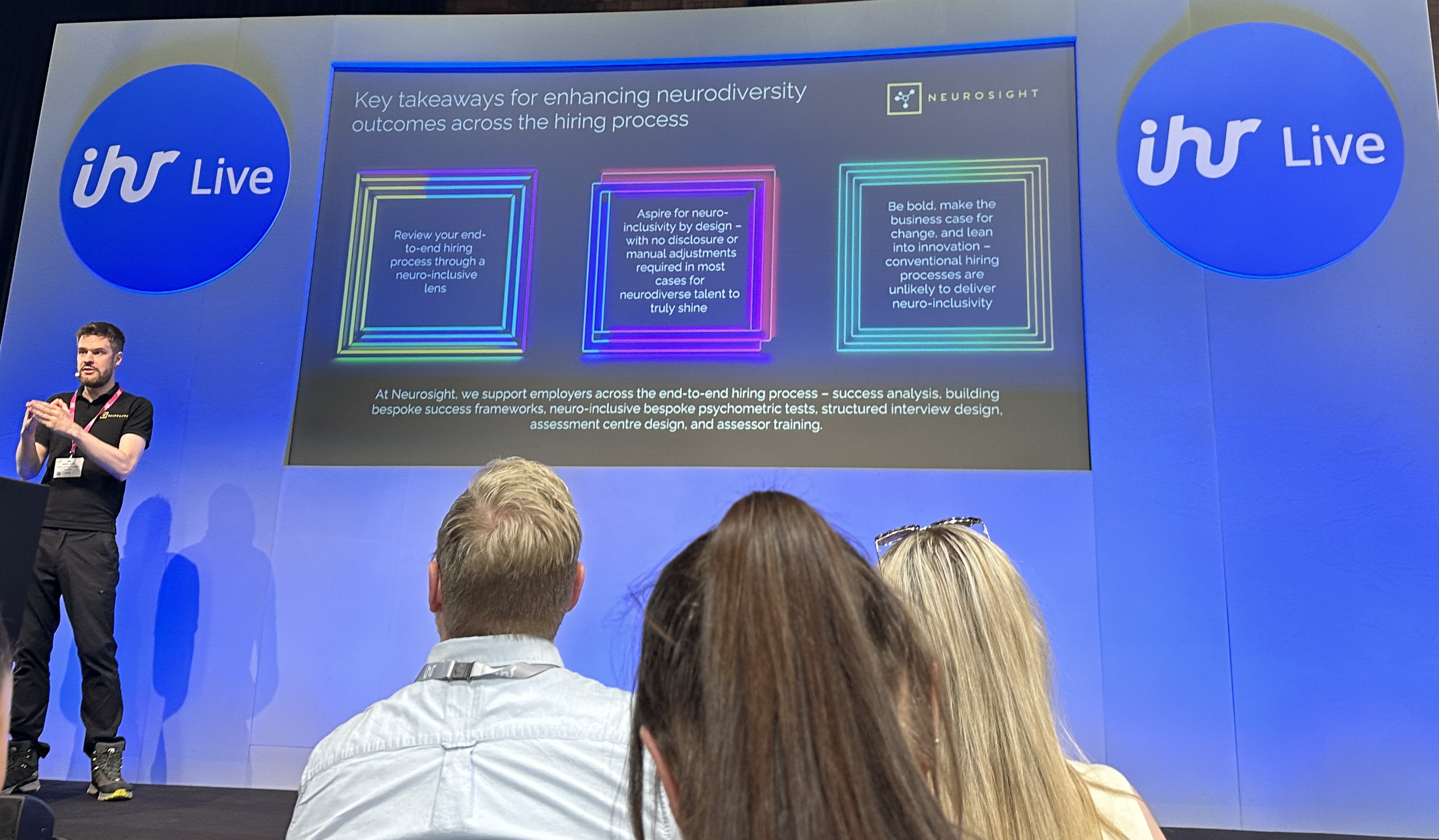
One of IHR Manchester 2025 sessions, delivered by Neurosight’s Jamie Betts, highlighted a key statistic - just 22% of adults with an autism diagnosis are employed. This raises the question: Is this caused by unintentional bias, or is it more likely that the hiring process is full of barriers that place neurodivergent candidates at a disadvantage?
There are ways to support neurodivergent candidates through every stage of the hiring process, to avoid unintentionally disadvantaging great talent. Below are some examples of reasonable adjustments that encourage neuroinclusive recruitment.
Application stage:
- Use clear and concise job descriptions, avoiding jargon and clearly defining the essential skills and responsibilities of the role.
- Highlight essential skills and qualifications that are necessary for the job. Avoid "nice-to-have" requirements that may unnecessarily exclude qualified candidates.
- Consider using a skills-based assessment approach.
Interview stage:
- Offer clear instructions and expectations in advance. This can include the interview location, duration and format.
- Educate your assessors about neurodiversity, use structured questions and scoring.
- For in-person interviews, consider lighting and noise.
- Remove group interviews and assessments.
Assessment centre stage:
- Significant barriers include navigating group dynamics, networking activities, or unpredictable scenarios.
- If in person, offer a quiet candidate breakout room, making it clear there’s no expectation to network.
- Ensure the environment doesn’t have sensory overload triggers, such as poor lighting, noise, or room layouts.
Post-final stage:
- Offer clear, constructive, and timely feedback, including areas for improvement and development.
- Post-offer, engage in a proactive dialogue related to in-role accommodations and support, offering a second opportunity to disclose neurodivergence, which can help the organisation to remove any further barriers in the workplace.
- For successful candidates, consider sharing the structure and timetable of their induction plan in advance, allowing them to mentally prepare.
The barriers faced by neurodivergent applicants are often unintentional, but they are also avoidable when employers build flexibility and understanding into each stage of the hiring journey. As we recognise Neurodiversity Celebration Week, it’s a timely opportunity for organisations to pause and reflect on the candidate experience they currently offer to each candidate.
By embedding neuroinclusive practices now, employers not only strengthen their talent pipelines but also create fairer processes that enable every candidate to demonstrate their true potential, supporting more inclusive, diverse and innovative teams.
FAQs
Frequently asked questions about Neuroinclusive recruitment.