






/Eploy-Blog-Banner.png?center=0%2C0&height=175&heightratio=1.915151515151515&width=336)
To build a high-performing candidate sourcing strategy, Talent Acquisition teams require clear visibility into what’s working — and what isn’t. That’s where Candidate Sourcing Metrics come in to reveal all.
In this blog, we cover:
- Why Candidate Sourcing Metrics Matter.
- Whether regularly measuring your sourcing channels improves performance.
- Key Metrics for Measuring Candidate Sourcing Success.
- Actionable tips to make the most out of the data in your hands.
This blog is just the tip of the iceberg. We’ve created a handy Recruitment Metrics Cookbook, your practical guide that contains all the formulas, explanations, and recruitment dashboards you need to measure what matters.
Why Do Candidate Sourcing Metrics Matter?
According to the UK Candidate Attraction Report 2025, over 23% of in-house recruitment teams struggle with a limited recruitment marketing budget, making it critical to invest wisely in sourcing channels.
Candidate sourcing metrics provide clarity on:
- Which channels deliver the right candidates
- Whether you’re spending your budget effectively
- Where bottlenecks occur in your recruitment funnel
- How sourcing quality differs by role type, location, or seniority
With accurate sourcing data, recruiters can optimise their strategy, plan more effectively, and reduce wasted time and cost.
Does regularly measuring your sourcing channels improve performance?
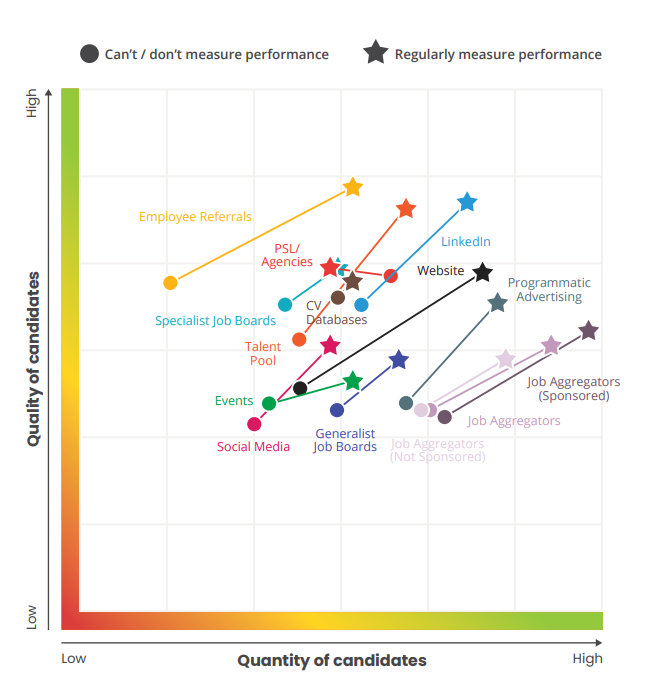
Measuring channel success ensures improved results. Looking at the data of the UK Candidate Attraction Report 2025, it becomes clear that recruitment teams, who regularly measure channel effectiveness, report improved candidate quality and increased numbers. This is especially noticeable with career websites, which, when regularly measured, help talent acquisition teams attract a higher quantity and quality of candidates.
Key Metrics for Measuring Candidate Sourcing
Below is an overview of the essential sourcing metrics every talent team should track — all included in Chapter One of the Recruitment Metrics Cookbook.
Candidate Source
Candidate Source shows where your applicants are coming from — job boards, aggregators, social media, like LinkedIn, career sites, referrals and more.
Measuring candidate source enables TAs to optimise recruitment by identifying:
- The most effective channels
- Reducing cost-per-hire
- Improving applicant quality
It enables data-driven decisions on where to allocate marketing budget to achieve the best results and enhances overall hiring speed as you’re not waiting for a poor channel to convert into a highly qualified hire. Measuring Candidate Source ensures a higher return on investment (ROI) by focusing resources on productive sources.
Application Drop‑Off Rate
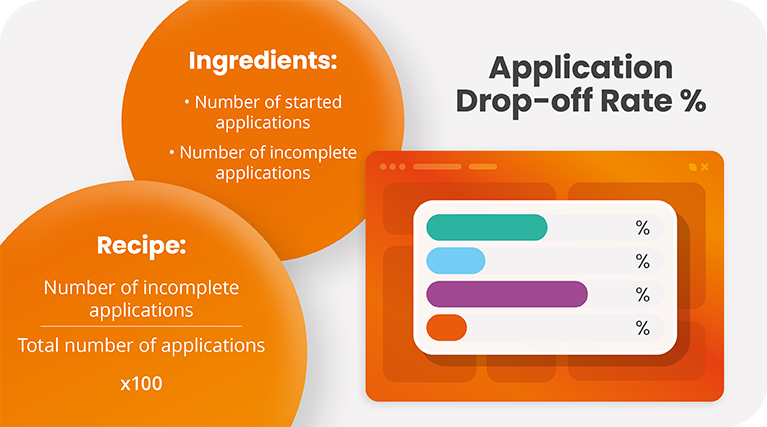
Great sourcing means nothing if all the great candidates you attract abandon your application process.
The Application Drop-Off Rate tells you how many candidates start but don’t finish an application — a major indicator of candidate experience.
High drop‑off can suggest:
- Overly lengthy or complex application form
- Poor mobile experience
- Unnecessary friction early in the process (e.g., asking for NI number upfront)
- Inability to pause and resume the application at a more convenient time
By analysing where candidates drop out, you can streamline their journey, significantly improve candidate experience and have more suitable candidates successfully submit their applications.
Qualified Candidates per Job
It’s not just about how many candidates you can attract — understanding the quality of talent is also crucial.
Qualified Candidates per Job metric reflects how many candidates make it past your initial screening stage.
Tracking this by department, job family or location helps you understand:
- Which roles attract high-quality talent
- Whether your job adverts are targeting the right audience
- Where screening time will be high or low
It’s one of the most valuable ways to assess sourcing channel effectiveness in terms of candidate quality.
Recruitment Funnel Throughput
Recruitment Funnel Throughput maps how candidates progress through each stage — from application to interview to offer — helping you forecast how many candidates you need at the top of the funnel to make a successful hire. This insight is invaluable for workforce planning, which is seen as a priority by 30% of in-house recruitment teams who participated in the Candidate Attraction Survey shaping the 2025 report.
Application to Hire Ratio
This is one of the most versatile sourcing metrics — telling you both how effective your advertising is and how much time you will spend recruiting certain roles.
Tracking Application to Hire ratio by channel helps you answer questions like:
- Are we more likely to hire from a niche job board or a job aggregator?
- Which roles overwhelm us with high application volume but low quality?
- Do we need better screening tools or more targeted advertising?
It’s one of the clearest ways to link sourcing activity to actual hiring outcomes.
Turning Insight into Action
Once you begin measuring these sourcing metrics consistently, several strategic opportunities open up:
- Better clarity over the most effective use of the recruitment budget .
- Ability to forecast hiring timelines based on historical data.
- Visibility of application process bottlenecks helps improve candidate experience and reduce drop-offs.
- Data-based approach to targeting the most effective sourcing channels for each role.
- Strengthened partnerships with stakeholders through data transparency.
Recruiters gain more control, hiring managers get clearer expectations, and candidates enjoy a smoother journey.
Eploy’s Applicant Tracking System enables you to measure what matters most to your team with useful dashboards built to suit your recruitment needs. They can be shared across teams, help track customisable KPIs and feedback surveys, providing your Talent Acquisition team with full visibility of the most relevant and recent recruitment metrics in one place. Learn more about Eploy’s recruitment analytics and dashboards here.
/Positive-trading-banner.png?center=0%2C0&height=187&heightratio=1.5215311004784688&width=284)

''Eploy features built-in dashboards and reporting tools that provide recruiters and hiring managers with clear visibility into important metrics such as time-to-hire, source effectiveness, and candidate funnel performance. These insights empower teams to make informed, data-driven decisions and to continually refine their hiring strategies.''
/Jemma-Mastrocristino.jpg?center=0%2C0&height=45&heightratio=1&width=45)
Jemma Mastrocristino
Head of Talent, AM Fresh Group

Want to Go Deeper? Download the Full Cookbook
Chapter One focuses on Candidate Sourcing, but the full cookbook covers:
- Process efficiency metrics
- Diversity & Inclusion analytics
- Recruitment KPI tracking
- And much more...
Download the full Recruitment Metrics Cookbook to start optimising your entire hiring process using key recruitment data.
Eploy's FAQs
Frequently Asked Questions about Candidate Sourcing Metrics